Polo Shirt Tech Pack Template
A tech pack built for one garment: the piqué polo shirt. The flat-knit collar, the button placket, the cuffs and the side vents each get their own lines, with sixteen points of measure and a complete filled-in example. Free as a PDF or an Excel file, with no email required.
Our general tech pack template works for any garment. This version is for polo shirts only: the size chart lists the 16 points a polo shirt is measured on, and the materials, construction, label and packaging tables already name the parts of a polo shirt, so you fill in values rather than work out what to ask for. The sections and their order are the same, so any factory reads it the usual way.
The PDF is the blank form, three A4 pages to print and fill in by hand, with a light outline of a polo shirt in the sketch boxes to draw over. The Excel file is the same form with every box already filled in for an invented brand, in grey italics to type over. We publish it as a factory that reads these documents every week; our polo shirt manufacturing page covers fabrics and minimums.
What is a polo shirt tech pack?
A polo shirt tech pack is the document a factory makes your polo from. It names the body fabric by knit, composition and GSM, describes the collar, cuffs, placket and buttons, gives every point of measure in each size with a tolerance, and lists the stitches, labels, packaging and order quantities. Ours fits on three A4 pages.
What the template looks like
Three A4 pages, shown here in full. Nothing is hidden behind a form.
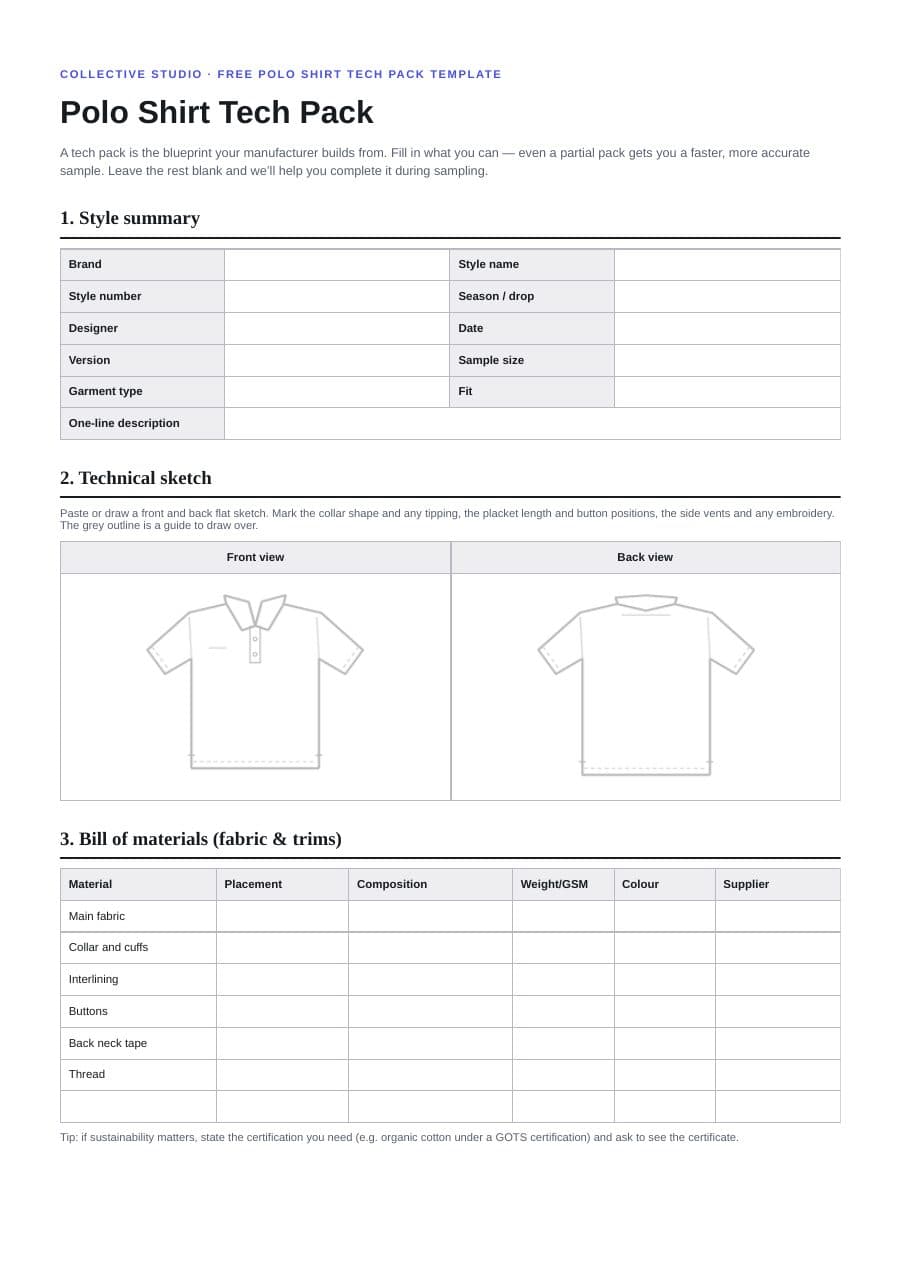
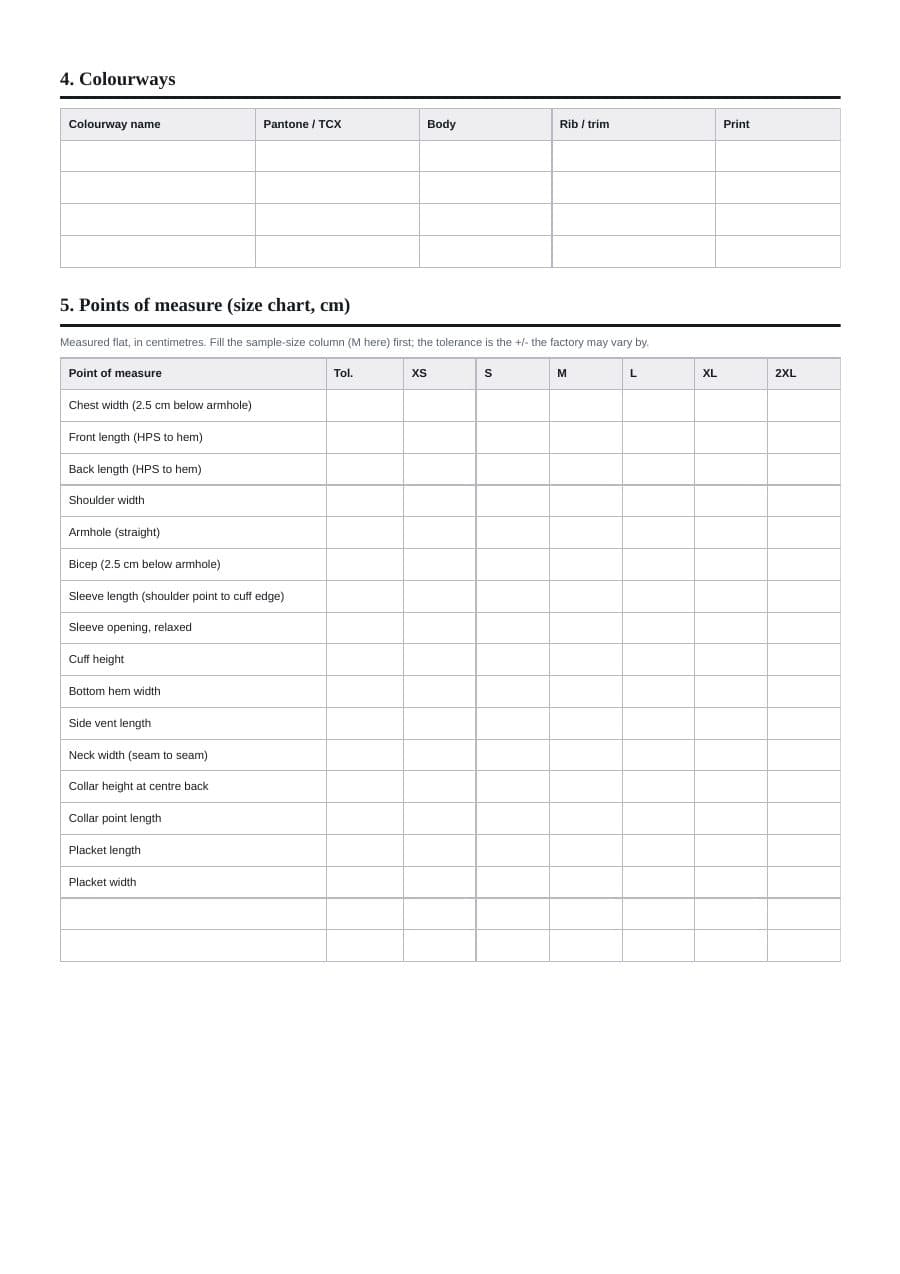
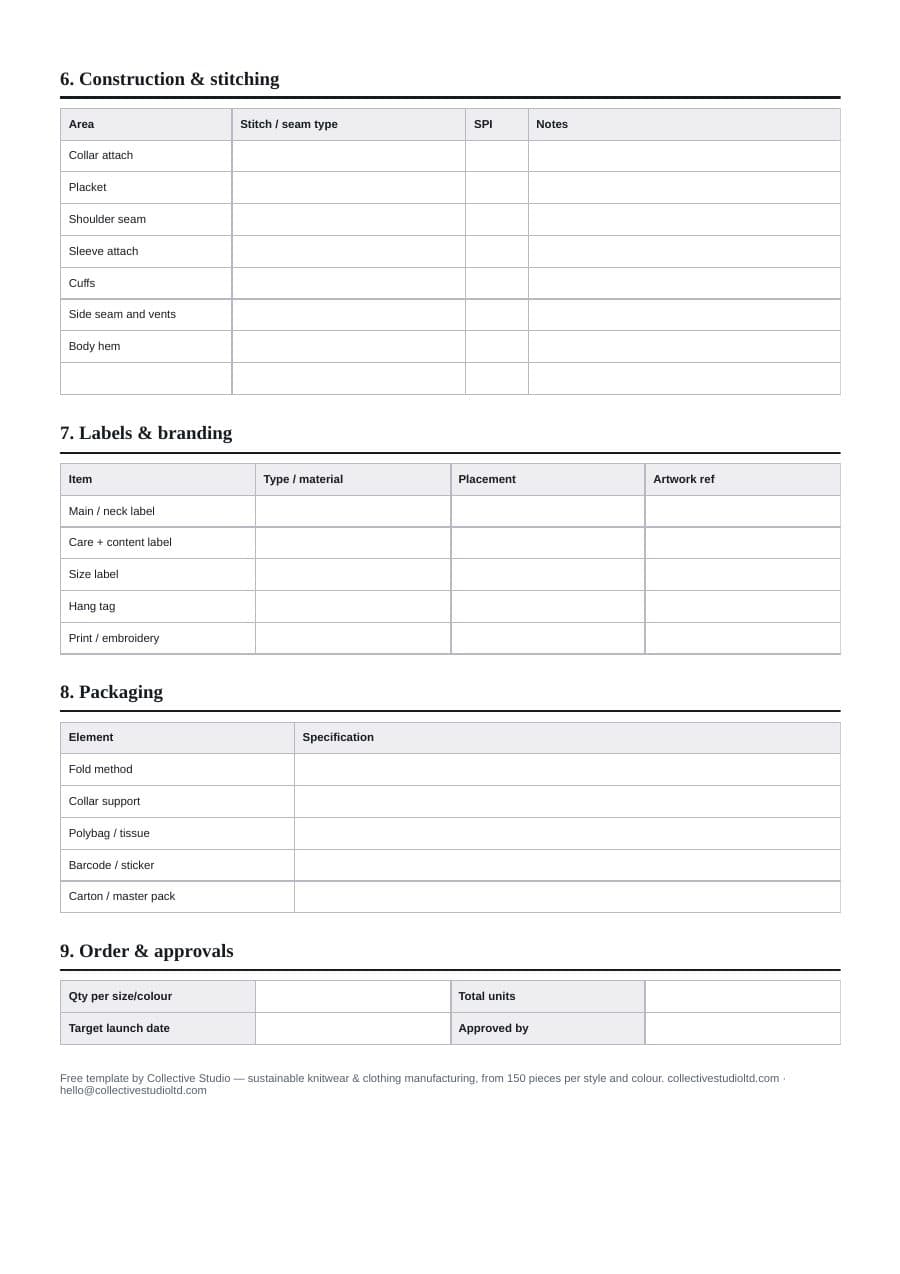
Polo Shirt size chart example
The example in the Excel version is a classic short-sleeve polo in single piqué with a flat-knit collar and cuffs, a two-button placket and side vents. Here is the part a factory reads most closely, graded from XS to 2XL. The brand and the numbers are invented to show the level of detail; measure a polo shirt you like and use your own.
| Point of measure | Tol. (+/-) | XS | S | M | L | XL | 2XL |
|---|---|---|---|---|---|---|---|
| Chest width (2.5 cm below armhole) | 1 | 48 | 50.5 | 53 | 55.5 | 58 | 60.5 |
| Front length (HPS to hem) | 1 | 67 | 69 | 71 | 73 | 75 | 77 |
| Back length (HPS to hem) | 1 | 70 | 72 | 74 | 76 | 78 | 80 |
| Shoulder width | 1 | 41 | 43 | 45 | 47 | 49 | 51 |
| Armhole (straight) | 0.5 | 21 | 22 | 23 | 24 | 25 | 26 |
| Bicep (2.5 cm below armhole) | 0.5 | 18 | 19 | 20 | 21 | 22 | 23 |
| Sleeve length (shoulder point to cuff edge) | 0.5 | 20 | 20.5 | 21 | 21.5 | 22 | 22.5 |
| Sleeve opening, relaxed | 0.5 | 15 | 15.5 | 16 | 16.5 | 17 | 17.5 |
| Cuff height | 0.3 | 2.5 | 2.5 | 2.5 | 2.5 | 2.5 | 2.5 |
| Bottom hem width | 1 | 48 | 50.5 | 53 | 55.5 | 58 | 60.5 |
| Side vent length | 0.3 | 5 | 5 | 5 | 5 | 5 | 5 |
| Neck width (seam to seam) | 0.5 | 16.5 | 17 | 17.5 | 18 | 18.5 | 19 |
| Collar height at centre back | 0.3 | 7 | 7 | 7 | 7 | 7 | 7 |
| Collar point length | 0.3 | 7.5 | 7.5 | 7.5 | 7.5 | 7.5 | 7.5 |
| Placket length | 0.5 | 13 | 13.5 | 14 | 14.5 | 15 | 15.5 |
| Placket width | 0.2 | 3 | 3 | 3 | 3 | 3 | 3 |
Measured flat, in centimetres. Fill the sample-size column (M here) first; the tolerance is the +/- the factory may vary by.
How to measure each point
Lay the garment flat, smooth it without stretching it, and measure with a soft tape in centimetres. The grade is how much each point grows from one size to the next in this example.
- Chest width (2.5 cm below armhole)
- Straight across from side seam to side seam, 2.5 cm below the bottom of the armhole.ExampleM 53 cm · ±1 cm · grade 2.5 cm a size
- Front length (HPS to hem)
- From the high point of the shoulder, where the shoulder seam meets the collar, straight down to the front hem edge.ExampleM 71 cm · ±1 cm · grade 2 cm a size
- Back length (HPS to hem)
- From the same point straight down the back to the back hem edge. In our example the back is 3 cm longer than the front.ExampleM 74 cm · ±1 cm · grade 2 cm a size
- Shoulder width
- Straight across the back from one shoulder point, where the sleeve is set in, to the other.ExampleM 45 cm · ±1 cm · grade 2 cm a size
- Armhole (straight)
- In a straight line from the shoulder point down to the bottom of the armhole, along the sleeve seam.ExampleM 23 cm · ±0.5 cm · grade 1 cm a size
- Bicep (2.5 cm below armhole)
- Across the sleeve, at right angles to its top fold, 2.5 cm below the bottom of the armhole.ExampleM 20 cm · ±0.5 cm · grade 1 cm a size
- Sleeve length (shoulder point to cuff edge)
- From the shoulder point along the top fold of the sleeve to the bottom edge of the cuff, cuff included.ExampleM 21 cm · ±0.5 cm · grade 0.5 cm a size
- Sleeve opening, relaxed
- Straight across the bottom edge of the cuff, laid flat and not stretched.ExampleM 16 cm · ±0.5 cm · grade 0.5 cm a size
- Cuff height
- From the cuff seam to the bottom edge of the flat-knit cuff.ExampleM 2.5 cm · ±0.3 cm · same in every size
- Bottom hem width
- Straight across the bottom edge, side seam to side seam, with the vents laid closed.ExampleM 53 cm · ±1 cm · grade 2.5 cm a size
- Side vent length
- From the front hem edge up the side seam to the bartack at the top of the vent.ExampleM 5 cm · ±0.3 cm · same in every size
- Neck width (seam to seam)
- Straight across the neck opening, from the collar seam at one high point of the shoulder to the other.ExampleM 17.5 cm · ±0.5 cm · grade 0.5 cm a size
- Collar height at centre back
- With the collar laid flat and open, from the collar seam at centre back to the outer edge of the collar.ExampleM 7 cm · ±0.3 cm · same in every size
- Collar point length
- Along the front edge of the collar, from the collar seam to the tip of the point.ExampleM 7.5 cm · ±0.3 cm · same in every size
- Placket length
- From the collar seam at centre front straight down to the bottom of the placket box.ExampleM 14 cm · ±0.5 cm · grade 0.5 cm a size
- Placket width
- Straight across the finished placket, from one edge to the other.ExampleM 3 cm · ±0.2 cm · same in every size
Materials and construction example
The bill of materials and the construction table from the same example. A factory buys fabric against composition and weight, and sews to the stitch named for each seam, so these two tables decide most of the price and most of the finish.
| Material | Placement | Composition | Weight |
|---|---|---|---|
| Main fabric | Body and sleeves | 100% combed cotton single piqué | 210 GSM |
| Collar and cuffs | Collar, sleeve cuffs | Flat-knit, 95% cotton, 5% elastane, one tipping stripe | — |
| Interlining | Placket | Fusible knit interlining | — |
| Buttons | Placket, 2 per shirt plus 1 spare | 4-hole button, 11.5 mm | — |
| Back neck tape | Back neck, shoulder to shoulder | Self-fabric piqué tape, 1.2 cm | — |
| Thread | All seams | 100% polyester, core-spun | — |
| Area | Stitch / seam | Notes |
|---|---|---|
| Collar attach | 4-thread overlock, back neck covered with self-fabric tape, 12 SPI | Collar ends finish flush with the placket edges; tape topstitched shoulder to shoulder |
| Placket | Self-fabric placket with fused interlining, single-needle lockstitch topstitch, 12 SPI | 3 cm wide, 14 cm finished; box stitch at the base; two vertical buttonholes, buttons cross-stitched |
| Shoulder seam | 4-thread overlock, 12 SPI | Taped so it does not stretch |
| Sleeve attach | 4-thread overlock, set-in, 12 SPI | Sleeve eased into the armhole |
| Cuffs | Flat-knit cuff attached with 4-thread overlock, 12 SPI | 2.5 cm finished; tipping matches the collar |
| Side seam and vents | 4-thread overlock to the top of the vent, 12 SPI | 5 cm vents, bartacked at the top of each; back 3 cm longer than front |
| Body hem | 2-needle coverstitch, 12 SPI | Hem depth 2 cm, carried round the vents |
SPI is stitches per inch. Labels: main / neck label (centre back neck, under the back neck tape); care + content label (left side seam, 8 cm above the top of the vent); size label (under the main label); hang tag (looped through the main label); print / embroidery (left chest, 17 cm below the HPS and 9 cm from centre front).
What a polo tech pack needs that a T-shirt one doesn't
The collar decides the shirt
A polo is judged at the collar first, and a collar that curls after a few washes makes the whole shirt look cheap. Say what it is: a flat-knit collar, knitted to shape with a finished edge, or a self-fabric collar with an interlining fused inside. Give its height at centre back, its point length and its composition, and say whether it contains elastane for recovery. Our example uses a flat-knit collar in 95% cotton and 5% elastane.
Placket, buttons and buttonholes
Give the placket's finished length and width, the number of buttons, and whether it is self-fabric with an interlining or a separate applied piece. Name the buttons by type, holes, size in millimetres and colour, and say whether a spare goes on the care label. State whether the buttonholes run along the placket or across it, so the sample is not the factory's guess.
Tipping is knitted in, not added
A contrast stripe on the collar and cuff edge is knitted into the trim with a second yarn, so it has to be specified before the collars are made and cannot be added later. Give its colour, its width and where it sits on the edge. Each body and tipping combination is its own collar lot, so count them when you plan colourways.
Side vents and a longer back
Most polos have short vents at the side seam, and many have a back a few centimetres longer than the front so the shirt stays tucked in. Give the vent length and the front and back lengths separately, and ask for a bartack at the top of each vent so the side seam does not split.
Piqué, jersey or interlock
Piqué is the classic polo cloth: its honeycomb texture breathes and hides creases. Jersey is smoother and drapes more; interlock is a double knit, heavier and more structured. We make piqué at 190 to 220 GSM. Write the knit and the weight, such as 100% combed cotton single piqué at 210 GSM, rather than just cotton.
Taped shoulders and a covered back neck
A polo goes on over the head through the placket opening, so the shoulders and the neck take the strain. Ask for taped shoulder seams and a back neck seam covered with self-fabric tape, which also keeps the inside neat when the collar is turned up. These are construction lines, not extras, so write them in.
For the fabric side, read what piqué is, interlock, the smoother double knit and rib knit. To work out how much fabric an order needs, try the fabric consumption calculator.
Adapting the template for other polo styles
The example is a classic short-sleeve piqué polo with a two-button placket. Long-sleeve, jersey and self-fabric-collar polos use the same three pages; the table shows the lines that change. Our polo shirt manufacturing page covers fabrics, collars and minimums.
| Style | Sketch and size chart | Materials and construction |
|---|---|---|
| Long-sleeve polo | Replace the short sleeve length and opening with the long sleeve length to the cuff edge and the relaxed cuff width. | Add a rib or flat-knit cuff for the long sleeve, with its height. |
| Three-button or longer placket | Lengthen the placket and mark each button position from the collar seam. | Change the button count in the bill of materials, plus a spare. |
| Jersey or interlock body | Same points of measure; recheck the fit on the sample, because jersey drapes more and interlock holds its shape. | Change the main fabric line to the knit and weight you want. |
| Self-fabric collar | Give the same collar height and point length. | Replace the flat-knit collar with self-fabric and a fused interlining, and add a fusing row to construction. |
| Hemmed sleeve instead of a cuff | Replace the cuff height with the sleeve hem depth. | Replace the cuff row with a coverstitched sleeve hem. |
The template is drawn for a short-sleeve piqué polo. Other polo styles use the same three pages; these are the lines that change.
Templates for other garments
- T-shirt tech pack template
- Hoodie tech pack template
- Jogger tech pack template
- Sweatshirt tech pack template
- Shorts tech pack template
- General tech pack template, for any other garment
- Tech pack checklist, if you prefer a tick-list
What clients say
Best supplier! On time, reliable and perfect craft.
Collective Studio is up and coming. Very hard working people who want to please their customers and grow partnerships together. Homaira is very knowledgeable in the knit industry and always willing to learn more. We are looking to grow our business with them.
Frequently asked questions
What should a polo shirt tech pack include?
The nine standard sections, with the collar and placket filled in properly. A style summary with the fit and the sample size. Front and back flat sketches marking the collar shape, any tipping, the placket and button positions and the side vents. A bill of materials naming the body fabric by knit, composition and weight, such as 100% combed cotton single piqué at 210 GSM, plus the collar and cuffs, the placket interlining, the buttons, the back neck tape and the thread. Colourways with Pantone TCX references for the body and the tipping. A size chart: ours has sixteen points, including front and back length, collar height and point length, placket length and width and the vent length, because chest and length alone leave the collar to guesswork. Then construction for each seam, label and embroidery placement, packaging, and the order split by size and colour.
How do you stop a polo collar curling?
Specify the collar properly, because curling is almost always a collar construction problem rather than bad luck. A polo collar is a separate piece, and it needs something holding it flat. Either choose a flat-knit collar knitted with elastane for recovery, or a self-fabric collar with an interlining fused inside, heavy enough for the collar fabric. Cheap polos skip the interlining or use one that is too light, and the points roll after a few washes. In the bill of materials, give the collar's type, composition and any tipping. In the size chart, give its height at centre back and its point length with a tight tolerance, such as plus or minus 0.3 cm. In construction, ask for the back neck to be covered with tape. Then wash the sample and check that the points lie flat before you approve it, because the first wash is where curl shows.
How do you measure a polo shirt for a size chart?
Lay it flat, face up, with the buttons done up, smooth it without stretching and measure in centimetres. Chest width runs straight across, side seam to side seam, 2.5 cm below the armhole. Measure the length twice: from the high point of the shoulder down the front to the front hem, then down the back to the back hem, because many polos have a longer back. For the collar, lay it open and measure its height at centre back and the length of each point along its front edge. Measure the placket from the collar seam to the bottom of the placket box, and its width edge to edge. Sleeve length runs from the shoulder point to the cuff edge, and the sleeve opening straight across the cuff, relaxed. Our example uses a 53 cm chest and a 71 cm front length in size M. A polo you already like is the best starting point.
What buttons should a polo tech pack specify?
Name them as precisely as the fabric: the type, the number of holes, the diameter in millimetres, the material and the colour, plus how many go on each shirt and whether a spare is sewn to the care label. Our example uses two 4-hole buttons of 11.5 mm on the placket, dyed to match the body, with one spare. Say how they are sewn, with a cross or a parallel stitch, and whether the buttonholes run vertically along the placket or horizontally across it. Vertical buttonholes are the usual choice on a knitted placket, because they follow the line of the strip. Buttons are a bought-in trim with their own supplier and their own colour matching, so decide them before sampling rather than after. If the polo is for children, buttons can be a small-parts hazard, so check the safety rules in each market you sell into before you approve the sample.
Is there a free polo shirt tech pack template?
Yes. Collective Studio's polo shirt tech pack template is free on this page as a printable PDF and an Excel file, with no email address or sign-up. It is built for a classic short-sleeve piqué polo, so the collar, cuffs, button placket and side vents each have their own lines. The size chart has sixteen points of measure from XS to 2XL, more than any of our other templates, because a polo is measured at the front and back separately and at the collar, placket and vents. The bill of materials already lists the piqué body fabric, the flat-knit collar and cuffs, the placket interlining, the buttons, the back neck tape and the thread. The Excel file is a complete example for an invented brand, a 210 GSM piqué polo in classic blue and white with contrast tipping, in grey italics to type over. The PDF is the blank form to fill in by hand.
How do I specify collar tipping on a polo shirt?
Give the tipping its own colour, width and position, and decide it before sampling, because tipping is knitted into the collar and cuffs with a second yarn rather than added afterwards. A contrast stripe on a flat-knit collar is made as the collar is knitted, so it cannot be changed once the collars exist. In the bill of materials, describe the collar and cuffs as flat-knit, with their composition, such as 95% cotton and 5% elastane, and note one tipping stripe. In the colourways table, give the body colour and the tipping colour for each colourway with Pantone TCX references; our example pairs a classic blue body with white tipping and a white body with classic blue tipping. Mark on the sketch where the stripe sits on the edge, and ask for the cuff tipping to match the collar. Each body and tipping combination is its own collar lot, so count them when you plan colourways.
How long should a polo shirt placket be, and how is it made?
Give the placket's finished length and width in the size chart, then describe how it is built, because the placket is where a polo opens and where it takes strain. Our example has a self-fabric placket 3 cm wide and 14 cm long, with a fused knit interlining inside to keep it flat, topstitched with a single-needle lockstitch and closed with a box stitch at the base. It carries two vertical buttonholes, and the buttons are cross-stitched. Measure the placket from the collar seam to the bottom of the placket box. A longer placket or a three-button front means a longer measurement, each button position marked from the collar seam, and a new button count in the bill of materials, plus a spare. Say whether the placket is self-fabric with an interlining or a separate applied piece, so the sample is not the factory's guess. Keep the tolerances tight: ours are 0.5 cm on length and 0.2 cm on width.
Should a polo shirt have side vents and a longer back?
Most polos have both, and the tech pack has to give the measurements, because neither is assumed. Side vents are short openings at the bottom of each side seam that let the shirt sit over the hips. A back a few centimetres longer than the front keeps the shirt tucked in when the wearer bends. In our example the vents are 5 cm long, with a bartack at the top of each so the side seam does not split, and the back is 3 cm longer than the front. The body hem is a 2-needle coverstitch, 2 cm deep, carried round the vents. In the size chart, give the front length and the back length separately, both measured from the high point of the shoulder, plus the vent length with a tight tolerance. Mark the vents on the sketch. If you want a straight hem with no vents, say so in the style summary.
What fabric and GSM should I write in a polo shirt tech pack?
Write the knit, the composition and the weight as a number, such as 100% combed cotton single piqué at 210 GSM, rather than just cotton. Piqué is the classic polo cloth: its honeycomb texture breathes and hides creases. Jersey is smoother and drapes more, and interlock is a double knit, heavier and more structured. Collective Studio makes piqué polos at 190 to 220 GSM. If you switch the body to jersey or interlock, the points of measure stay the same, but recheck the fit on the sample, because jersey drapes more and interlock holds its shape. The collar and cuffs need a line of their own: either a flat-knit trim with a little elastane for recovery, or a self-fabric collar with a fused interlining. Combed yarn gives a smoother face than carded and takes print more cleanly. If you are not sure of the weight, send a polo you like and the factory can weigh it.
Download the polo shirt template (PDF)Download the Excel version (.xlsx)Send us your tech pack